Mediterranean Diet Meal Planner — AI Plans from Your Pantry
AI-generated Mediterranean diet meal plans built around olive oil, fish, vegetables, legumes, and whole grains — using only the foods you already have at home. See how it works →
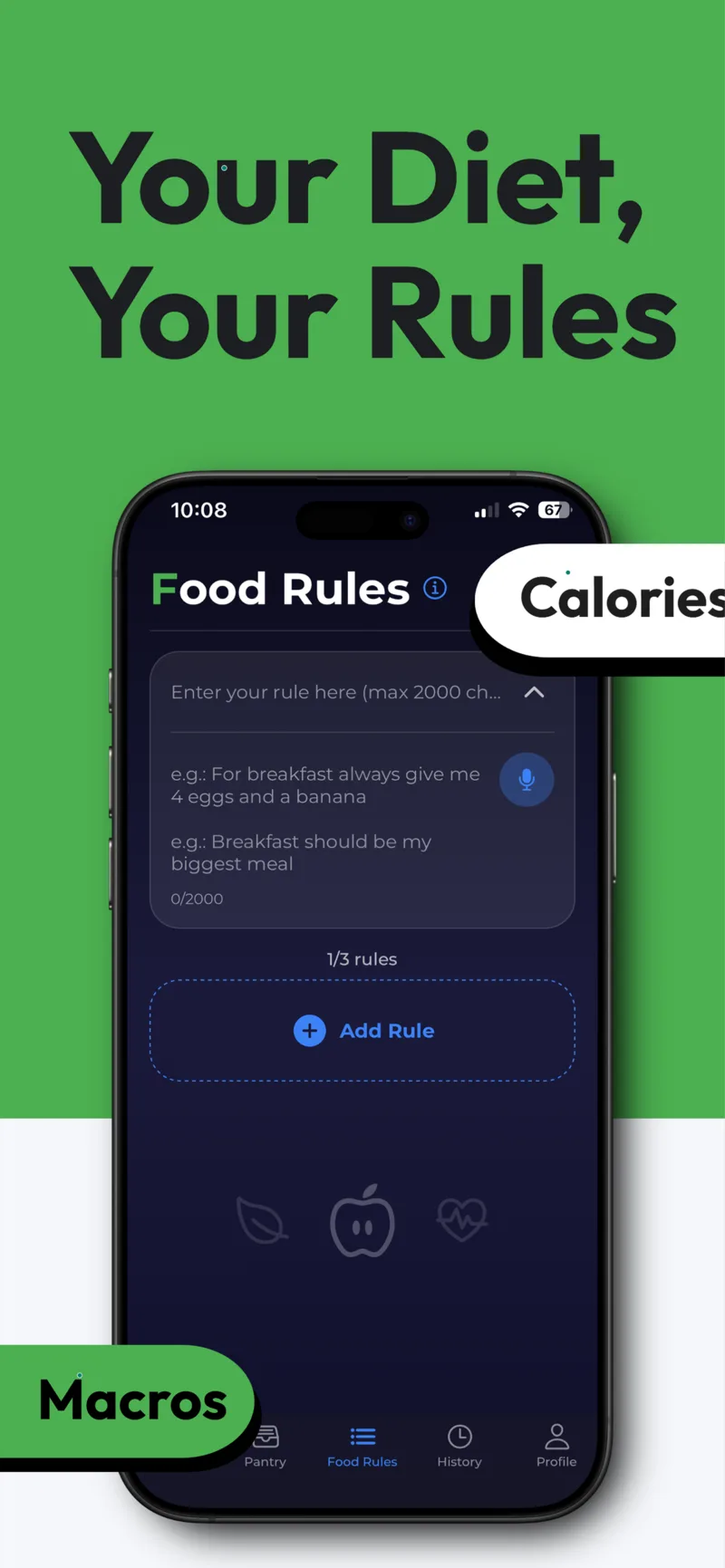
TL;DR: Set dietary rules like "olive oil as primary fat", "fish at least twice per week", and "limit red meat to once per week" once, stock your pantry with Mediterranean staples (olive oil, tomatoes, legumes, whole grains, fish, herbs), and the AI generates complete Mediterranean meal plans that hit your macro targets every time. No recipe hunting, no guessing portions, no broken rules.
Quick Answer: What is a Mediterranean diet meal planner?
A Mediterranean diet meal planner is a tool that generates complete daily or weekly meal plans aligned with the traditional eating pattern of Mediterranean countries — extra virgin olive oil as the primary fat, lots of vegetables, fruits, whole grains, legumes, nuts, fish at least twice a week, moderate dairy and poultry, and limited red meat. An AI-powered Mediterranean meal planner like Qedamio goes further: it calculates exact portions to hit your calorie and protein targets, respects your dietary rules on every plan, and uses only the foods you already have in your pantry. The result: actionable, heart-healthy meal plans without the recipe research.
In this guide:
→ What Is the Mediterranean Diet, Really?
→ Mediterranean vs Other Popular Diets
→ Why Mediterranean Meal Planning Is Harder Than It Looks
→ How Qedamio Works for Mediterranean Meal Planning
→ Mediterranean Diet Food List — What to Stock
→ Why AI Meal Planning Works for the Mediterranean Diet
→ Mediterranean Macros — What the Split Usually Looks Like
→ Who Should (and Should Not) Follow the Mediterranean Diet
→ Mediterranean Diet by Goal
→ Common Mistakes — And How AI Prevents Them
→ Frequently Asked Questions
Free tier — what you get:
• 7 lifetime AI meal plan generations (no credit card required)
• Unlimited pantry items across unlimited custom sections
• 3 custom Food Rules (e.g. "olive oil as primary fat", "fish twice per week")
• Monthly calorie & macro calculator (BMR / TDEE)
• Full meal plan history with search, favorites, and calendar assignment
What Is the Mediterranean Diet, Really?
Key facts (as of 2026):
• Originated in Crete, Southern Italy, and Spain; documented in the 1960s
• Formalized by Ancel Keys in the Seven Countries Study
• PREDIMED trial (N Engl J Med, 2018): ~30% reduction in major cardiovascular events
• Ranked #1 overall diet by U.S. News & World Report for multiple consecutive years
• Endorsed by the American Heart Association, Harvard T.H. Chan School of Public Health, and the Academy of Nutrition and Dietetics
The Mediterranean diet is not a trademarked meal plan or a strict calorie formula — it is an eating pattern documented in the 1960s in Crete, Southern Italy, and Spain, and formalized by researcher Ancel Keys in the Seven Countries Study. It is the most heavily researched dietary pattern in nutrition science. The PREDIMED trial, published in the New England Journal of Medicine in 2018, showed a ~30% relative risk reduction in major cardiovascular events for people following a Mediterranean diet supplemented with extra virgin olive oil or nuts. The pattern is also supported by the Harvard T.H. Chan School of Public Health, which highlights its protective effects against heart disease, type 2 diabetes, and cognitive decline.
The pattern is built on a few clear principles:
- Extra virgin olive oil is the primary fat — used for cooking, dressing, and finishing.
- Plant foods dominate — vegetables, fruits, whole grains, legumes, nuts, and seeds at every meal.
- Fish and seafood at least twice a week — especially fatty fish like sardines, salmon, and anchovies.
- Moderate poultry, eggs, and dairy — mostly yogurt and cheese, in reasonable amounts.
- Limited red meat — a few times a month, not a few times a week.
- Minimal refined grains, added sugars, and processed foods — these are not part of the traditional pattern.
- Herbs and spices in place of salt — oregano, basil, rosemary, thyme, parsley, garlic.
This is flexible enough to work for almost anyone, which is why it is consistently ranked the #1 overall diet by U.S. News & World Report. The challenge is translating the pattern into real meals that hit your calorie and protein targets — and that is where AI meal planning comes in.
Mediterranean vs Other Popular Diets
Understanding how Mediterranean compares to other patterns helps you set the right Food Rules in your meal planner:
| Diet | Primary Fat | Animal Products | Refined Carbs | Typical Focus |
|---|---|---|---|---|
| Mediterranean | Olive oil | Fish, moderate dairy/poultry, rare red meat | Limited | Heart health, longevity |
| Keto | Butter, coconut, animal fat | High (meat, eggs, cheese) | None | Fat loss, ketosis |
| Vegan | Plant oils, nuts | None | Varies | Ethical, health |
| Paleo | Animal fat, olive oil | High (meat, eggs, fish) | None (no grains/legumes) | Whole foods, ancestral |
| DASH | Olive oil, nuts | Low-fat dairy, lean meat, fish | Limited | Blood pressure |
| Standard Western | Seed oils, butter | High red meat, processed | High | (Default pattern) |
Mediterranean and DASH share the most overlap — both emphasize whole foods, olive oil, and limited red meat. The Mediterranean pattern is slightly more flexible and includes more fats from olive oil and nuts, while DASH is stricter on sodium. Both are well-supported by research.
Why Mediterranean Meal Planning Is Harder Than It Looks
On paper, the Mediterranean diet sounds simple: eat vegetables, olive oil, and fish. In practice, most people fall into the same traps: not enough olive oil (the signature ingredient), too much bread and pasta (refined instead of whole grain), not enough legumes, too much cheese, and fish only when eating out.
Hitting the pattern consistently means deciding every day how much olive oil to use, which fish to cook twice a week, how to rotate legumes without eating the same hummus three days in a row, and how to balance all of it against your calorie and protein goals. For someone building muscle, the challenge is even harder: the classic Mediterranean pattern is carb- and fat-forward, so you need to strategically slot in higher-protein foods like Greek yogurt, fish, seafood, and eggs without breaking the pattern.
A personalized AI meal planner · Meal Planning Statistics 2026 solves exactly this. It knows which foods are Mediterranean-compliant, which are calorie-dense, and how to combine them so your daily totals hit your goals. No manual calculations, no "is this Mediterranean enough?" second-guessing, no pattern drift over time.
How Qedamio Works for Mediterranean Meal Planning

- Set Mediterranean Food Rules: Create rules once, like "Olive oil as primary fat, no vegetable oils", "Fish or seafood at least twice per week", "Limit red meat to once per week", or "Include legumes daily". The AI follows these rules on every plan.
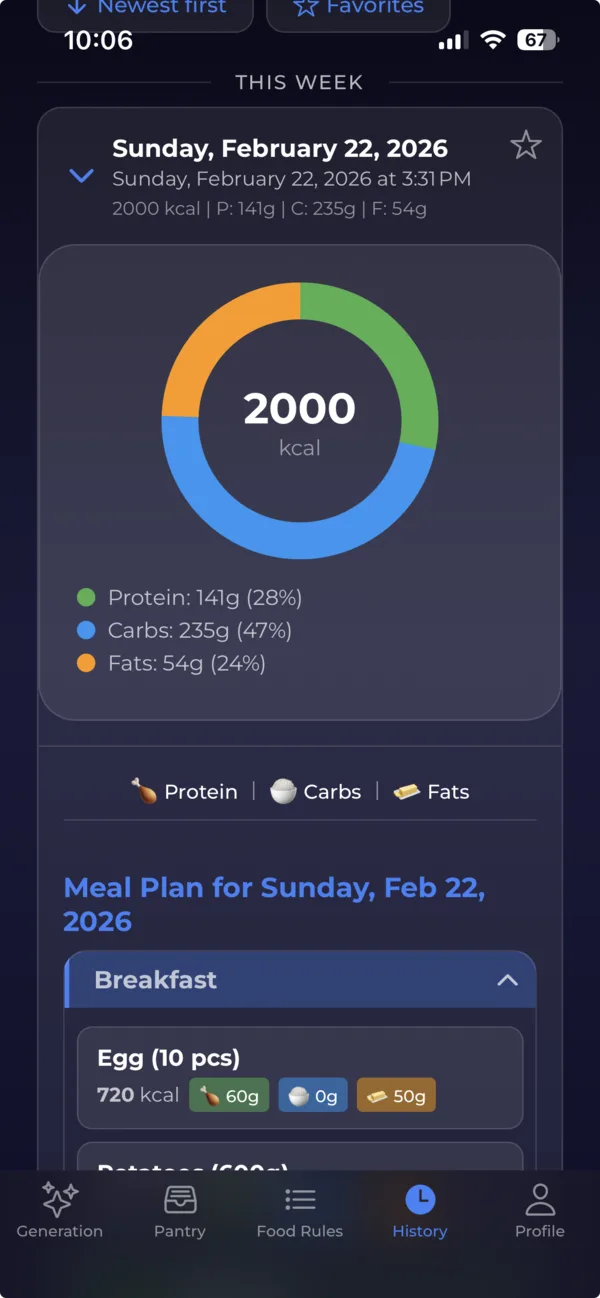
- Calculate Your Macros: Use the built-in macro calculator to find your calorie, protein, carb, and fat targets. Mediterranean plans typically run higher in healthy fats (35–40% of calories) from olive oil, nuts, and fish.
- Stock a Mediterranean Pantry: Add extra virgin olive oil, tomatoes, leafy greens, legumes, whole grains (farro, bulgur, whole wheat pasta), canned fish (sardines, tuna, anchovies), nuts, Greek yogurt, feta, and herbs. The AI uses strictly these foods — it never invents ingredients.
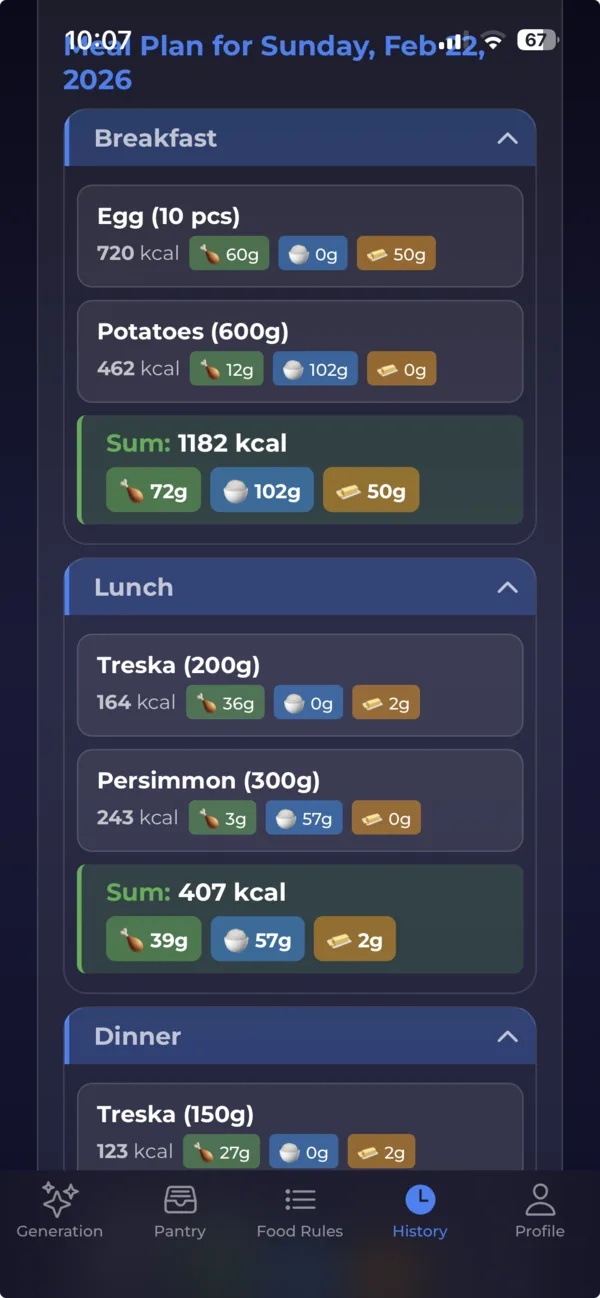
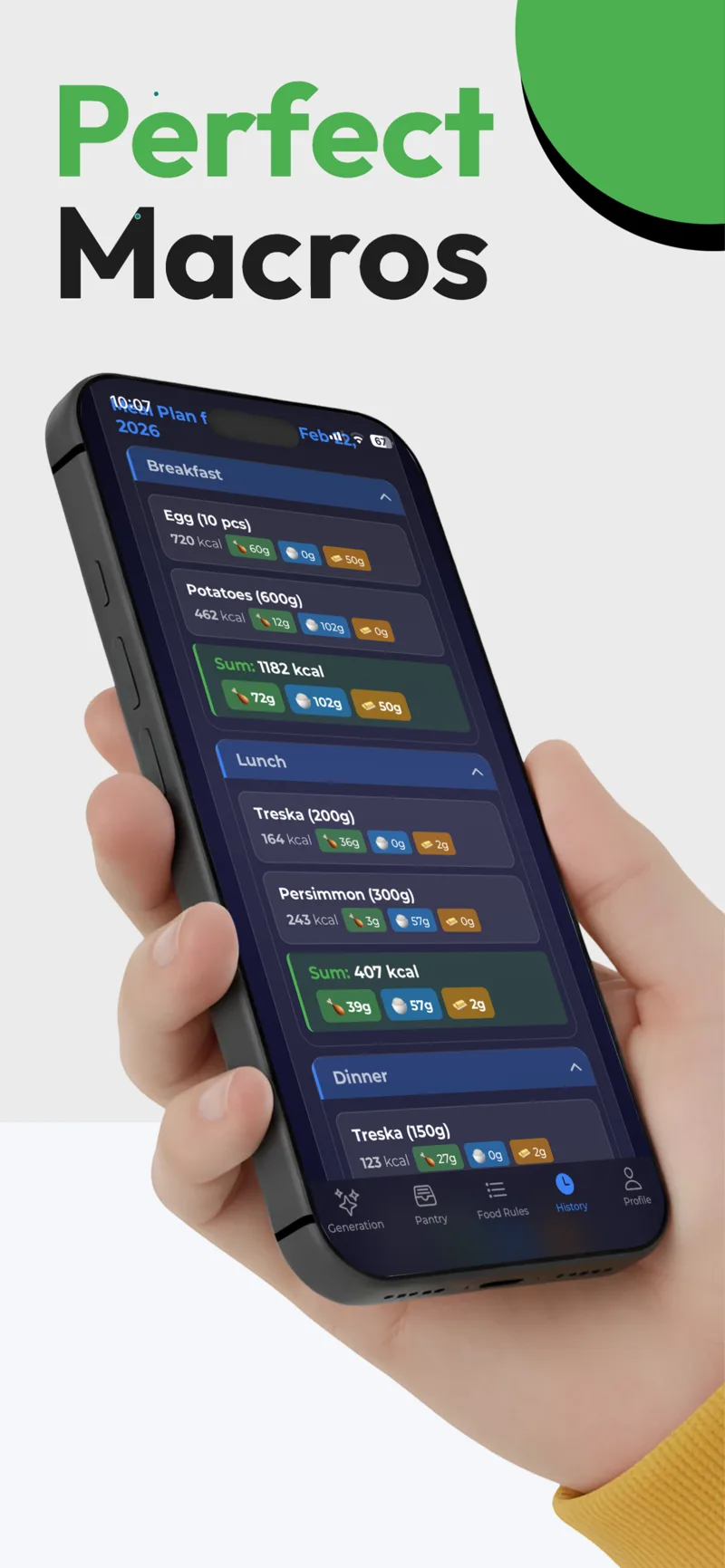
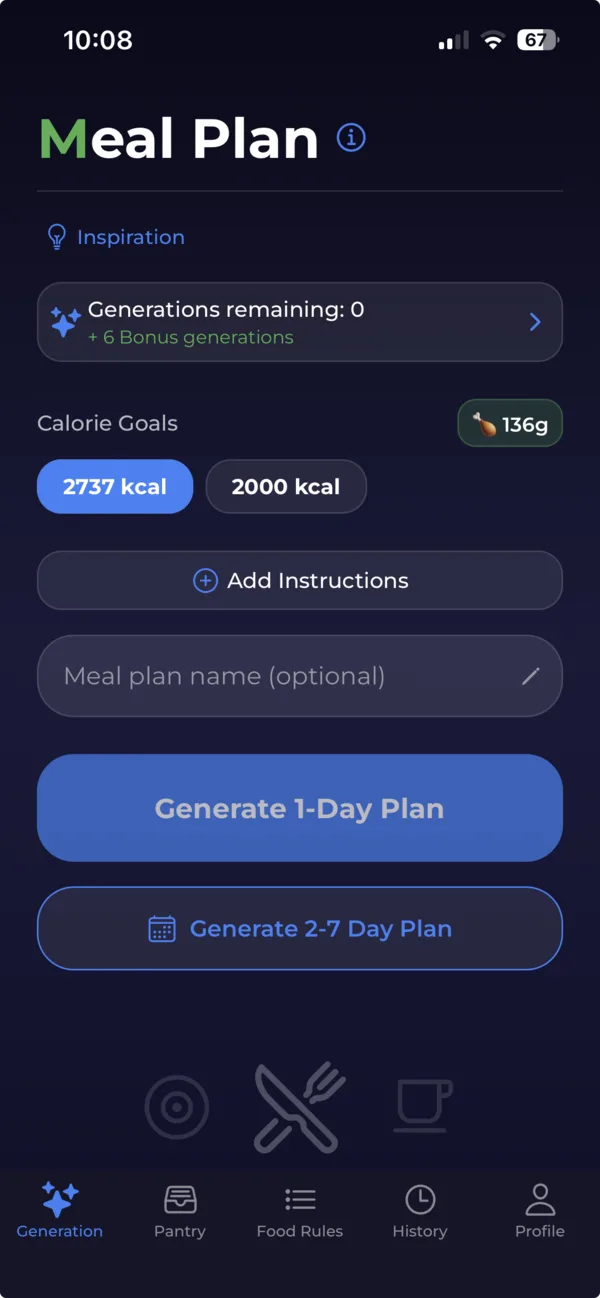
- Generate: Get a complete Mediterranean meal plan with exact portions, per-meal macros, and quick prep instructions. Every plan respects your rules and hits your targets.
Mediterranean Diet Food List — What to Stock in Your Pantry
The Mediterranean diet is genuinely pantry-friendly. Most staples have long shelf lives (olive oil, legumes, grains, canned fish, nuts) and the fresh ingredients are common produce. Here is the full Mediterranean diet food list by category, with typical daily or weekly servings:
| Category | Core Foods | Typical Serving | Why It Matters |
|---|---|---|---|
| Fats | Extra virgin olive oil, olives, walnuts, almonds, pistachios, pine nuts, tahini | 2–4 tbsp olive oil daily; 30g nuts daily | Primary energy source, polyphenols, omega-3s |
| Vegetables | Tomatoes, leafy greens, eggplant, zucchini, bell peppers, onions, garlic, artichokes, cucumbers, fennel | 3–5 servings per day (400–600g) | Fiber, vitamins, volume without calories |
| Fruits | Lemons, oranges, figs, grapes, pomegranate, berries, melon, dates | 2–3 servings per day | Natural sweetness, antioxidants |
| Whole Grains | Farro, bulgur, barley, whole wheat pasta, couscous, brown rice, oats | 3–6 servings per day (cooked 150–200g each) | Fiber, B vitamins, steady energy |
| Legumes | Chickpeas, lentils, white beans, fava beans, black-eyed peas | At least 1 serving daily (150–200g cooked) | Plant protein, fiber, iron |
| Fish & Seafood | Sardines (fresh or canned), anchovies, salmon, tuna, mackerel, shrimp, mussels | At least 2 servings per week (120–150g each) | Complete protein, omega-3s (EPA/DHA) |
| Dairy (moderate) | Greek yogurt, feta, parmesan, ricotta, halloumi | 1–2 servings daily (150g yogurt or 30g cheese) | Protein, calcium, probiotics |
| Eggs & Poultry | Eggs, chicken, turkey | Eggs: up to 4/week; poultry: 2–3 servings/week | Protein — use moderately |
| Red Meat | Beef, lamb, pork | Once per week maximum (100g) | Occasional only; not a daily protein source |
| Herbs & Spices | Oregano, basil, parsley, rosemary, thyme, mint, garlic, paprika, black pepper | Used freely in every meal | Flavor without salt or sugar |
Tip: Canned fish (sardines, tuna, anchovies) is one of the most underrated Mediterranean staples — cheap, shelf-stable, and rich in protein and omega-3s. Stocking 6–10 cans means you can always hit the "fish twice a week" rule without a trip to the fresh counter.
Why AI Meal Planning Works for the Mediterranean Diet
Pattern-Based, Not Recipe-Based
The Mediterranean diet is a pattern, not a fixed recipe book. That makes it perfect for AI meal planning. Instead of rotating through the same 15 recipes you found online, the AI builds fresh combinations from your pantry every time — a farro bowl with chickpeas and roasted vegetables today, a sardine and white bean salad tomorrow, shakshuka with feta the day after. Variety is the default, not an effort.
Olive Oil Portion Control
Olive oil is 120 kcal per tablespoon. Use it generously and you can easily hit 800+ calories a day just from oil — which is how the traditional Cretan diet worked, because energy demands from manual labor were much higher. For modern sedentary bodies, that same approach stalls fat loss. The AI calibrates olive oil portions to your actual calorie target, so you get the flavor and the polyphenols without blowing your macros.
Food Rules Lock In Your Mediterranean Style
Qedamio's Food Rules are what make Mediterranean planning automatic. Set rules once and they apply to every plan:
- "Use extra virgin olive oil as primary fat, no seed oils" (classic pattern)
- "Include fish or seafood at least twice per week" (omega-3 baseline)
- "Limit red meat to once per week maximum" (cardiovascular rule)
- "Include legumes daily" (fiber and plant protein)
- "Every meal must include vegetables" (volume and micronutrients)
- "No refined sugar or white flour" (traditional pattern)
- "Include nuts or seeds daily" (healthy fats, vitamin E)
- "Minimum 30g protein per meal" (if muscle-building or cutting)
Pantry-First Means Less Waste
Mediterranean eaters often end up with forgotten cans of fish, half-used bags of lentils, and herbs wilting in the crisper. The AI uses strictly your pantry inventory — so every plan uses what you have before it goes bad. This connects directly to reducing food waste, which is already embedded in the traditional Mediterranean approach of "nothing goes to waste".
Try It With Your Own Pantry
Add your olive oil, legumes, grains, and fish — set a couple of Mediterranean rules — and let AI build your first plan in under a minute. 7 free plans. No credit card. No sign-up hoops.
Mediterranean Macros — What the Split Usually Looks Like
Unlike keto or standard bulking diets, the Mediterranean pattern does not prescribe exact macro ratios. But when you translate the traditional food intake into macros, it lands in a fairly consistent range:
| Macro | % of Calories | Primary Sources |
|---|---|---|
| Fat | 35–40% | Olive oil, nuts, fatty fish, olives, cheese |
| Carbs | 40–50% | Whole grains, legumes, fruits, starchy vegetables |
| Protein | 15–25% | Fish, Greek yogurt, legumes, eggs, poultry, cheese |
If you are an active person or training for muscle growth, you likely want to push protein higher (1.6–2.2g per kg body weight), which will pull the percentage up to the 20–30% range. This is easy to do on Mediterranean — just lean on Greek yogurt, fish, eggs, and legumes more heavily. For a complete ranking of the best protein sources by density and cost, see our high-protein foods guide. See our macro calculation guide for how to set your targets.
Who Should (and Should Not) Follow the Mediterranean Diet
The Mediterranean diet is one of the most broadly suitable eating patterns in nutrition science, but it is not a fit for every situation. Here is a realistic breakdown.
Great fit
- People with cardiovascular risk factors — the most strongly supported use case. PREDIMED specifically studied high-risk adults.
- Adults with type 2 diabetes or prediabetes — improved insulin sensitivity and HbA1c in multiple trials, according to Mayo Clinic.
- People who want sustainable weight loss — high satiety, whole foods, no banned food groups.
- Active adults and athletes — easy to push protein high via fish, Greek yogurt, eggs, and legumes.
- People who dislike strict diets — flexible pattern, no calorie counting required at entry level.
- Anyone reducing red meat or processed food — the pattern does this automatically.
Not a direct fit (consult a dietitian first)
- People following strict keto — Mediterranean macros include whole grains, fruit, and legumes, which break ketosis. See keto meal planner.
- People with specific allergies — fish, tree nuts, and dairy are core to the pattern. You can adapt, but set Food Rules carefully.
- People with chronic kidney disease — the high plant protein and potassium may need adjustment under medical guidance.
- Pregnant or breastfeeding women — the pattern is generally safe and recommended, but specific fish (high-mercury species) should be limited.
- Children with restricted diets — work with a pediatric dietitian before making significant changes.
Mediterranean Diet by Goal
Mediterranean for Weight Loss
This is where the Mediterranean diet shines. Fiber-rich vegetables, legumes, and whole grains are extremely satiating, and olive oil plus nuts keep meals satisfying without spiking hunger. Set a 300–500 kcal deficit below your TDEE and let the AI build Mediterranean plans that hit that target. The classic mistake is over-pouring olive oil (see below) — the AI controls portions automatically. See the full weight loss planner guide, or if you are cutting for body recomposition, keep protein at 2.0g/kg and drop calories more aggressively.
Mediterranean for Heart Health
The Mediterranean diet is the most strongly supported dietary pattern for cardiovascular disease prevention. According to the American Heart Association, it lowers LDL cholesterol, reduces inflammation, improves blood pressure, and lowers the risk of heart attack and stroke. If heart health is your primary goal, focus on: fish twice a week (especially fatty fish), legumes daily, olive oil as primary fat, and minimal processed foods or red meat. Set these as Food Rules and every plan will enforce them.
Mediterranean for Muscle Building
Yes, you can build muscle on a Mediterranean diet. You need a calorie surplus (200–300 kcal above TDEE) and 1.6–2.2g protein per kg body weight. The best high-protein Mediterranean foods are salmon, tuna, sardines, shrimp, Greek yogurt, eggs, chicken, cottage cheese, and legumes. The AI generates bulking plans using these sources from your pantry. For a full breakdown, see our muscle building meal planner guide, and for per-meal protein targeting see the high-protein planner.
Mediterranean for Meal Prep
Mediterranean foods are excellent for meal prep — cooked legumes, whole grains, and roasted vegetables keep 4–5 days in the fridge. Grain bowls, bean soups, and farro salads are perfect prep foods. Generate a multi-day plan (Pro tier), get a shopping list for the week, batch-cook once, and eat Mediterranean meals all week. The Pro tier supports 2–7 day plans with automatic variety across days so you do not eat the same thing twice. For weekly planning strategy, see our weekly meal planning guide.
Mediterranean for Busy Schedules
One of the biggest reasons people drop the Mediterranean pattern is time. Cooking from scratch every day is not realistic for most working adults. The AI solves this by generating plans that default to quick preparations — canned sardines on whole grain toast, Greek yogurt with nuts and berries, one-pan roasted vegetables with chickpeas. See our meal planner for busy people guide for strategies that preserve the pattern without adding hours of prep.
Common Mediterranean Diet Mistakes — And How AI Prevents Them
Editor's note: After reviewing hundreds of Mediterranean-style meal plans generated by Qedamio users, the same five failure patterns appear again and again. None of them are exotic — they are the boring, predictable drifts that happen when a "pattern" meets a real weekly schedule. The fixes below are the ones we have seen work.
1. Over-Pouring Olive Oil
Olive oil is the right fat, but it is still 120 kcal per tablespoon. Many people pour "freely" and add 400–600 kcal of hidden calories per day. The AI calculates exact teaspoons and tablespoons per meal so you stay in your target, and you see the fat macros on every meal.
2. White Bread and White Pasta Instead of Whole Grains
The traditional Mediterranean diet was built on whole grains — barley, farro, bulgur, whole wheat. Modern supermarkets push refined white versions, which lose most of the fiber and nutrients. Set a Food Rule like "No refined grains — whole wheat or whole grain only" and the AI will build every plan around whole-grain alternatives.
3. Skipping Fish
Fish at least twice a week is one of the most consistent rules across all Mediterranean diet research, but it is the one people skip most. The fix is stocking canned fish — sardines, anchovies, tuna, mackerel. Add a Food Rule like "Include fish or seafood at least twice per week" and the AI schedules it automatically across your plans.
4. Too Much Cheese, Too Little Legumes
Feta and parmesan are delicious and Mediterranean-appropriate, but they are not supposed to be the main protein source. Legumes are. A classic drift pattern is "Mediterranean" meals that are really just pasta with cheese. The AI distributes protein sources across the week so legumes appear daily and cheese stays in supporting role.
5. Calling Pizza "Mediterranean"
Modern American and British versions of "Mediterranean food" lean heavily on pizza, pasta carbonara, garlic bread, and tiramisu. These are traditional Italian dishes but they are not the everyday Mediterranean pattern documented in PREDIMED. The AI builds meals from whole, minimally-processed foods — if it is not in your pantry, it does not appear in the plan.
Key Takeaways:
• The Mediterranean diet is a pattern, not a recipe book — olive oil as primary fat, plants at every meal, fish twice a week, legumes daily, limited red meat.
• Macros typically land at 35–40% fat, 40–50% carbs, 15–25% protein. Push protein higher if training for muscle.
• Olive oil is the single most important food — use it generously but measured. Portion control matters for fat loss.
• Use Food Rules to lock in your Mediterranean style ("olive oil primary", "fish twice per week", "legumes daily", "no refined grains") — apply once, enforce forever.
• The Mediterranean pattern supports weight loss, muscle building, and long-term cardiovascular health simultaneously — few other diets do all three.
Frequently Asked Questions
What is the Mediterranean diet?
The Mediterranean diet is an eating pattern based on the traditional cuisine of Greece, Southern Italy, and Spain in the 1960s. It emphasizes extra virgin olive oil, vegetables, fruits, whole grains, legumes, nuts, fish at least twice a week, moderate dairy and poultry, and limited red meat. It is flexible, whole-food focused, and the most heavily researched dietary pattern in nutrition science.
How does AI help with Mediterranean diet meal planning?
AI turns the Mediterranean pattern into concrete daily meals that hit your calorie and macro targets. It calculates exact portions of olive oil, fish, legumes, and whole grains, and builds each meal around the foods in your pantry. Set dietary rules once and every plan respects them automatically.
Is the Mediterranean diet good for weight loss?
Yes. It is high in fiber, healthy fats, and lean protein, which keeps you full on fewer calories. The PREDIMED trial and multiple large studies show it supports sustainable weight loss and reduces the risk of heart disease and diabetes. Set a 300–500 kcal deficit and let AI build plans that hit that target.
Can you build muscle on the Mediterranean diet?
Yes. The Mediterranean pattern supports muscle building if you hit your protein target (1.6–2.2g per kg body weight) and maintain a calorie surplus. Fish, seafood, Greek yogurt, eggs, chicken, legumes, and cheese all fit within the pattern and provide high-quality protein.
What foods should I avoid on the Mediterranean diet?
Limit or avoid refined grains (white bread, white pasta), added sugars, sugar-sweetened beverages, processed meats, highly processed snack foods, refined vegetable oils, and heavy consumption of red meat. The pattern is built on whole, minimally processed foods.
Is olive oil really that important?
Yes. Extra virgin olive oil is the signature fat of the Mediterranean pattern and the most studied food in PREDIMED and related trials. It is rich in monounsaturated fats and polyphenols linked to lower cardiovascular risk and inflammation. Aim for 2–4 tablespoons per day.
How much olive oil should I eat per day?
The PREDIMED trial used 50g (roughly 4 tablespoons) of extra virgin olive oil daily in the Mediterranean-plus-olive-oil arm. For most adults, 2–4 tablespoons per day (25–50g) across cooking, dressings, and finishing is a reasonable target. If you are in a calorie deficit, stay on the lower end — olive oil is 120 kcal per tablespoon and adds up fast. The AI calculates exact amounts per meal so you never accidentally blow your fat budget.
Can I drink wine on the Mediterranean diet?
The traditional Mediterranean pattern includes moderate red wine with meals — typically one small glass (125ml) for women and up to two for men. However, current guidance from the American Heart Association and most health authorities is that if you do not already drink, there is no health reason to start. The cardiovascular benefits once attributed to wine are increasingly attributed to the overall diet pattern itself, not the alcohol. If you drink, keep it moderate, with meals, and count the calories (red wine is ~125 kcal per glass).
Is the Mediterranean diet expensive?
It does not have to be. The expensive reputation comes from fresh wild salmon, imported olive oil, and gourmet cheese — none of which are required. Canned sardines, dried lentils, bulk olive oil, seasonal vegetables, and store-brand whole grain pasta are all authentic Mediterranean staples and cost less per meal than most processed alternatives. Using a pantry-first meal planner also cuts waste, which further reduces real cost.
References
- Estruch R, Ros E, Salas-Salvadó J, et al. "Primary Prevention of Cardiovascular Disease with a Mediterranean Diet Supplemented with Extra-Virgin Olive Oil or Nuts." N Engl J Med. 2018;378(25):e34.
- Dinu M, Pagliai G, Casini A, Sofi F. "Mediterranean diet and multiple health outcomes: an umbrella review of meta-analyses of observational studies and randomised trials." Eur J Clin Nutr. 2018;72(1):30-43.
- Martínez-González MA, Gea A, Ruiz-Canela M. "The Mediterranean Diet and Cardiovascular Health." Circ Res. 2019;124(5):779-798.
- de Lorgeril M, Salen P, Martin JL, et al. "Mediterranean diet, traditional risk factors, and the rate of cardiovascular complications after myocardial infarction: final report of the Lyon Diet Heart Study." Circulation. 1999;99(6):779-785.
- Schwingshackl L, Schwedhelm C, Galbete C, Hoffmann G. "Adherence to Mediterranean Diet and Risk of Cancer: An Updated Systematic Review and Meta-Analysis." Nutrients. 2017;9(10):1063.
- Widmer RJ, Flammer AJ, Lerman LO, Lerman A. "The Mediterranean Diet, its Components, and Cardiovascular Disease." Am J Med. 2015;128(3):229-238.
← Back to AI Meal Planner · Related: Weight Loss Planner · High Protein Planner · Vegan Meal Planner · Pantry Meal Planner · Meal Prep Planner · Macro Meal Planner
Disclaimer: This article is for informational purposes only and does not constitute medical or nutritional advice. The Mediterranean diet is broadly considered safe and beneficial for most healthy adults, but individual needs vary. Consult a qualified healthcare professional or registered dietitian before making significant dietary changes, especially if you are pregnant, nursing, managing a medical condition (diabetes, kidney disease, cardiovascular disease), or on medications that interact with dietary changes.